
By Andrea Melloncelli | July 9, 2026
A corporate second brain keeps track of what happens in your company: emails, chat messages, prospects, proposals, invoices, the status of every project. It gives that material back when you need it, and it shows what is going wrong and what has become urgent, so you keep the whole picture in view. It also recognizes when a new situation resembles an old one, finds the solution that worked last time, and stops you repeating a mistake you have already made.
Over time it stops being a personal habit and becomes company infrastructure. It reconciles the different versions of the same facts that people hold, answers in line with how your company actually works, and captures the knowledge and internal procedures that today exist only in people's heads.
The cost of retrieving knowledge
“Do you remember the price we agreed in March?”
A client asks that on a Friday evening. You spend the next hour going through email, chat and an old spreadsheet to prove your own position. That hour is not unusual, and it adds up:
- 20% of working time goes into searching for information, one day out of five.
- 90% of the effort behind a report is duplicated, rebuilt from scratch by each person.
- 70% of company knowledge lives only inside people’s heads.
- Onboarding takes months, with a colleague pulled off work to teach.
This is the problem an AI second brain solves.

The building blocks: Obsidian + Claude
Obsidian lets you write down concepts and link them to each other freely, the way Wikipedia does. What comes out is a knowledge graph: your clients, projects and people, and the connections between them.
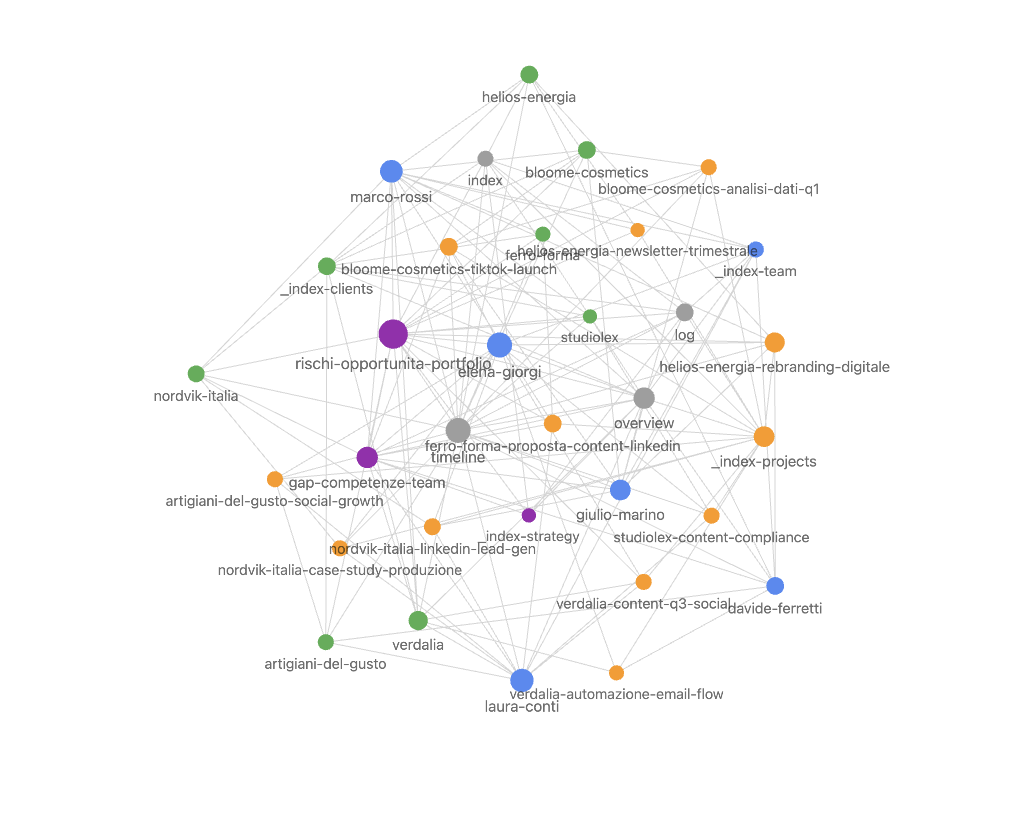
- One page per concept, linked to the others. Nothing more complicated than that.
- Claude, or any other AI agent, maintains the graph: it keeps the pages up to date and pulls out what you need, when you need it.
- The knowledge stays readable by every agent in the company, and by every colleague.
The method is not new: Tiago Forte’s CODE (Capture, Organize, Distill, Express) describes the same discipline. What is new is that it is now a tool in the hands of your agent.
Talking to your data
“How is revenue doing this year?”
Your documents, emails and meeting notes stay where they are. Claude writes a short note for each thing that matters, one per client, one per project, one per person, and opens only the two or three that hold the answer.
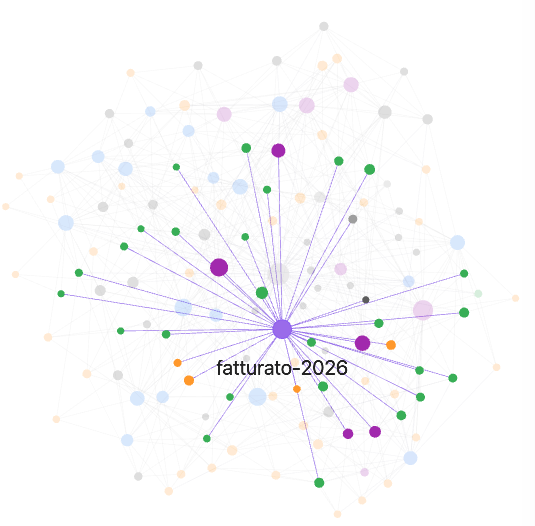
The answer is more than a number:
- Revenue is growing, but still below break-even.
- Almost 50% of turnover comes from one client, spread across five projects.
- No contract protects that relationship.
You are querying your company’s data, not talking to a chatbot. And because the files can include company documents and shared mailboxes, that data belongs to the organization rather than to one person.
Two questions you cannot answer today
“Which clients are at risk?”
- A content calendar approved in May, with compliments to the team.
- Three messages left unanswered.
- Samples promised for a shoot, never delivered.
- A small June invoice past its due date.
Each fact sits with a different colleague and means nothing alone. Together they describe a client who left six weeks ago without telling anyone.
“What happens if I lose a key person?”
- Video editing depends on one person, who leaves at the end of August.
- A delivery in mid September is uncovered.
- Two open offers, thirty thousand euros, become impossible to staff.
- The colleague joining in September writes copy, so the gap stays open.
Four facts, four different places: a skills record, a resignation date, a delivery calendar, a list of open offers. Together they are a decision to take in July, not in September.
Every owner asks both questions, usually at the worst possible moment. What has been missing is a place where the answer can be assembled.
Sharing and versioning
The brain is a folder of files, so sharing it needs no special machinery.
- Put it where your company already keeps shared documents. Every change reaches everyone.
- The conventions travel with it: whoever joins next year finds a method, not a pile of notes.
- Versioning restores an earlier state when a file is corrupted or a bad edit slips through.
- It also shows when a fact entered the record and what it replaced.
Knowledge that exists only in its latest version can be lost in a single afternoon, which is the situation you are trying to leave behind.
A new way of working
“The tedious part of maintaining a knowledge base is not the reading or the thinking, it’s the bookkeeping.”
Andrej Karpathy
The idea is his. The agent takes the bookkeeping. Then it goes further: it thinks with you over the base it has collected, and connects the dots between the facts. The base stays there for you to read yourself and discuss with the agent.
- You instruct the agent in the language you already use with your colleagues.
- No technical team is required to start.
- Each brain is shaped by how its owner organizes folders and thinks about the work.
- Less time spent remembering, more time spent deciding.
At Vanlog we work this way every day, and we teach companies to do the same. None of this has to be running by tomorrow, but the distance between the teams that know these tools and the teams that do not is still short enough to close.
Want to build a corporate second brain for your own business?
Get in touch →